

Top Industries Hiring in Chicago Right Now
|
If you’re looking for work in Chicago and want to focus on roles that actually move, it helps to zoom in on the industries that stay active even when the market feels uneven.
Right now, three lanes matter most for many Crown candidates: warehouse and logistics, light industrial and production support, and manufacturing. Those are not random picks. In April 2026, the Chicago metro area still had about 920,500 jobs in trade, transportation, and utilities and about 405,300 jobs in manufacturing.
World Business Chicago also describes Chicagoland as a central transportation and logistics hub, with a logistics workforce more than 200,000 strong, O’Hare as the nation’s busiest cargo airport, and one of the largest inland ports in the Western Hemisphere. In other words, moving goods is still one of Chicago’s biggest economic strengths.
The first industry to watch is warehouse and logistics. This is still one of the best entry points for job seekers who want fast-moving hiring cycles, shift flexibility, and a chance to build experience without needing a long list of credentials.
BLS says warehousing and storage is the largest employer for material moving machine operators, and because goods move around the clock, some of these jobs run overnight or on weekends. That matters in Chicago, where airport cargo, regional distribution, e-commerce, and freight activity create year-round demand.
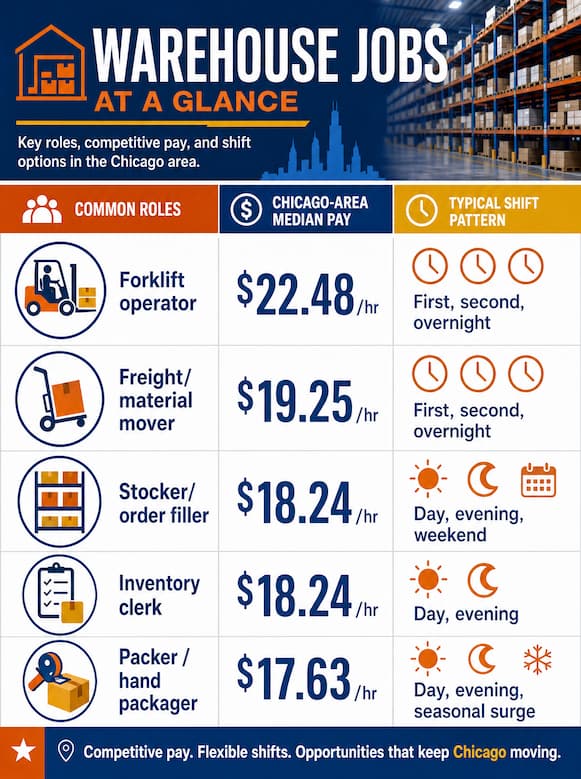
Common warehouse and logistics roles include forklift operator, freight/material mover, stocker/order filler, inventory clerk, and packer. Here’s what those look like in the Chicago area:
The second lane is light industrial. This is where a lot of candidates start when they want hands-on work but are not locked into one specialty yet. Light industrial roles often sit between warehousing and full-scale manufacturing.
Think packaging, sorting, staging, line support, inspection, and basic machine support. Illinois’ workforce-demand report is useful here because it shows ongoing statewide demand for stockers/order fillers and laborers/material movers, driven heavily by turnover and replacement needs. For job seekers, that usually means a lower barrier to entry and more chances to get started quickly if your attendance and work ethic are strong.
Then there is manufacturing. This lane usually offers the clearest long-term upside. World Business Chicago says Chicagoland’s future-readiness still depends in part on manufacturing and logistics, even as automation changes what many plants need.
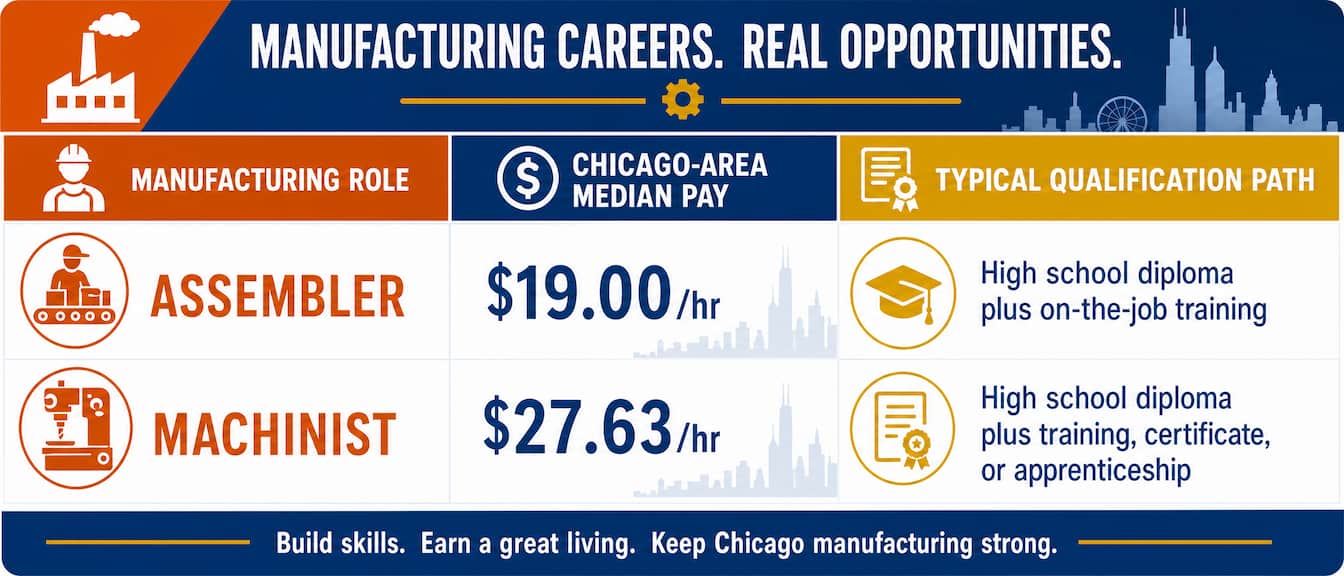
The best manufacturing jobs today are less about “just stand there and do one motion forever” and more about consistency, quality awareness, measurement, machine familiarity, and willingness to learn new systems. BLS says assemblers usually work full time and may work evenings, weekends, or shifts, while machinists may learn on the job, in apprenticeship, or through technical programs and often work regular business hours, though some shops run nights and weekends too.
Here are two Chicago manufacturing roles worth knowing:
A third manufacturing-support lane that job seekers should not overlook is maintenance and industrial repair. BLS says industrial machinery mechanics, maintenance workers, and millwrights are projected to grow 13 percent nationally from 2024 to 2034 and are needed more as automation expands.
Their work often happens in manufacturing facilities, on night or weekend shifts, and commonly includes overtime. This is not the easiest entry-level role, but it is one of the better “next step” targets if you already have mechanical interest or plant experience.
So how do you actually get hired through Crown for these kinds of jobs?
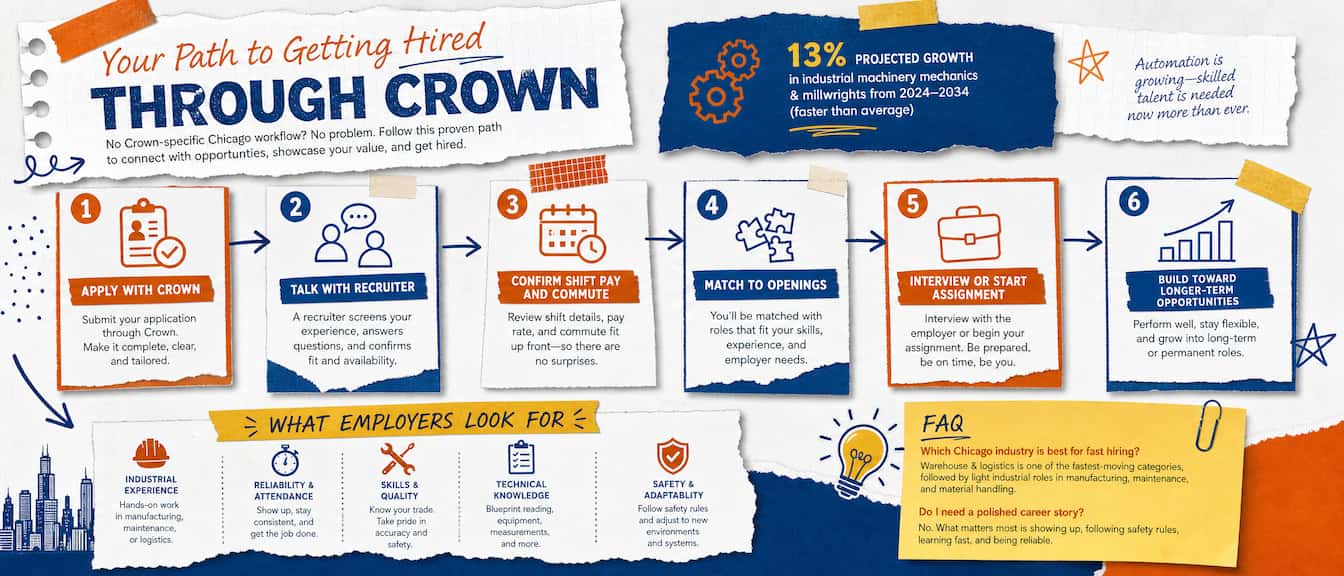
Because no Crown-specific Chicago workflow was provided in the brief, the smartest publishable framing is a standard recruiter path: apply once, speak with a recruiter, confirm your shift and commute preferences, highlight any industrial experience or certifications, and stay responsive when openings move quickly.
That matters because industrial hiring is often fast. Employers may not need a polished career story. They need someone who can show up, follow safety rules, and work the shift they agreed to.
This is the hiring path most candidates should expect:
The process below is a recommended staffing-agency workflow for these job categories, not a specific published Crown Chicago SOP. It is included to make the content practical and conversion-friendly.
If you want the strongest results, tailor your application to the lane you actually want. For warehouse work, lead with equipment, shipping, picking, packing, scanning, and attendance. For light industrial roles, lead with speed, quality, and reliability.
For manufacturing, mention measurement, machine operation, blueprint reading, setup help, inspection, or any technical courses. And if you have schedule flexibility, say it clearly. In Chicago’s current industrial market, availability is often an advantage.
Chicago’s summer hiring season is here.
Get connected with flexible seasonal jobs.